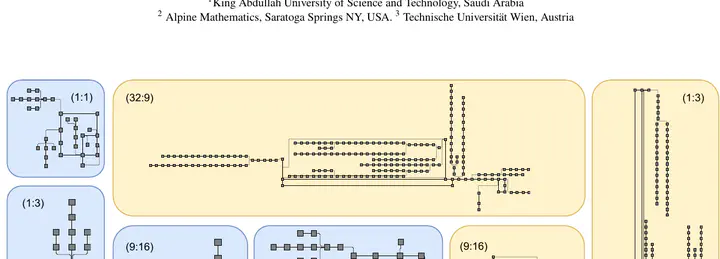
 Figure from the author-uploaded arXiv version.
At a glance
- Adds aspect-ratio control to orthogonal graph layout, for wide displays, tall mobile screens, and fixed panels.
- Builds on HOLA while preserving established readability goals such as compactness and low bend count.
- Uses a soft target aspect ratio rather than forcing a rigid post-hoc deformation.
Motivation
Orthogonal layouts make graphs easier to read in domains such as software, process, and biological-network visualization. Existing algorithms optimize local layout quality, but offer little control over the overall shape—a problem when the same graph must fit a wide display, a tall screen, or a fixed interface region.
Method
ARCOL extends the Human-like Orthogonal Layout Algorithm (HOLA) with a soft aspect-ratio objective. It introduces aspect-ratio awareness during core stress minimization and the subsequent placement of tree components, encouraging a requested shape while retaining the geometric constraints and readability conventions of orthogonal drawing.
Evaluation
The paper compares layouts across target aspect ratios and studies the resulting trade-offs in area, bends, crossings, and edge length. The evaluation shows that ARCOL can steer the global layout shape without treating aspect ratio as a purely post-processing operation.
Limitations
Aspect ratio is an additional layout objective, not a guarantee that every graph can meet an arbitrary target without compromises. Highly constrained graphs may still require trade-offs against compactness or other conventional quality measures.