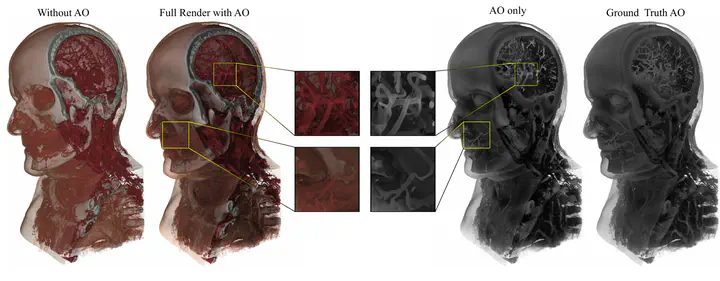
 Paper Fig. 1: DVAO predicts an ambient-occlusion volume from volume data and a transfer function.
At a glance
- Predicts per-voxel ambient occlusion for direct volume rendering with a 3D convolutional encoder–decoder.
- Treats the transfer function as global context and recomputes the occlusion volume only when that context changes.
- Best configuration: preclassifying the volume with transfer-function opacity gave the strongest reconstruction results.
- Generalizes beyond training data: trained on human head CT, then evaluated on animal CT, MRI, and electron microscopy data.
Motivation
Ambient occlusion improves depth perception in direct volume rendering, but high-quality volumetric illumination can be expensive to compute. DVAO investigates whether a learned model can precompute an ambient-occlusion volume for the current transfer function, leaving view changes interactive.
Method
DVAO is a 3D convolutional encoder–decoder that takes a scalar volume and transfer-function context and predicts one ambient-occlusion value per voxel. The strongest variant preclassifies the volume with transfer-function opacity, giving the network a spatially aligned, implicit representation of the global transfer function from its first layer.
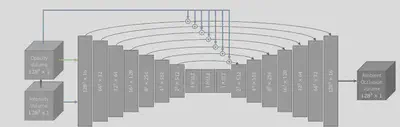
The selected implicit/preclassified strategy combines opacity and intensity volumes before the encoder and predicts a 128³ ambient-occlusion volume. Adapted from Fig. 6 of the arXiv version.
Evaluation
- Across 30 training runs covering six transfer-function injection strategies and five loss functions, the implicit preclassified input performed best; the selected DSSIM-2D + MSE model reached SSIM 0.875 and MSE 0.008 on held-out data.
- The default 16-filter model required 411 ms per transfer-function update on an RTX 2070. It is not evaluated every frame, so camera interaction remains responsive after the occlusion volume is produced.
- Although trained only on human head CT data, it obtained SSIM scores of 0.786 on mouse micro-CT, 0.866 on chameleon CT, 0.751 on MRI, and 0.869 on electron microscopy data.
Limitations
The prototype operates on 128³ volumes and needs substantial memory for 3D CNN inference. It was a research exploration of learned volumetric illumination rather than a replacement for optimized algorithmic ambient-occlusion methods.