EfficientMonoHair: Fast Strand-Level Reconstruction from Monocular Video via Multi-View Direction Fusion
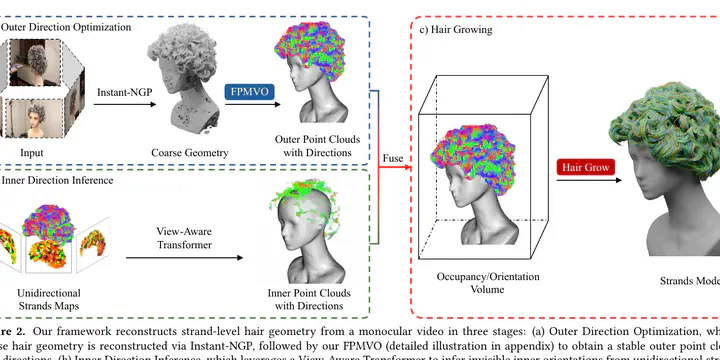 Figure from the author-uploaded arXiv version.
At a glance
- Reconstructs strand-level hair from a monocular video with an emphasis on speed and detail.
- Combines implicit reconstruction with multi-view geometric direction fusion.
- Uses fusion patches to reduce optimization work while preserving reliable outer-layer strand directions.
Motivation
Strand-level hair reconstruction must balance global shape, fine directional detail, and runtime. Implicit methods can capture a coherent hair mass but lose individual strands, while explicit optimization can be accurate but expensive and difficult to scale.
Method
EfficientMonoHair combines an implicit neural representation with multi-view geometric fusion. It samples hair directions across views, aggregates them with a fusion-patch optimization, and enforces patch-level consistency to create a direction-aware outer-layer point cloud from which strands can be reconstructed.
Evaluation
The work compares reconstruction quality and efficiency with existing monocular-video approaches across varied hairstyles. Its evaluation emphasizes the benefit of using multi-view direction evidence without the sequential optimization burden of earlier strand-growing pipelines.
Limitations
Very complex, heavily occluded, or highly curled hairstyles remain difficult because visible image evidence can be sparse or ambiguous. As with other monocular methods, reconstruction quality is coupled to capture coverage and input-image quality.