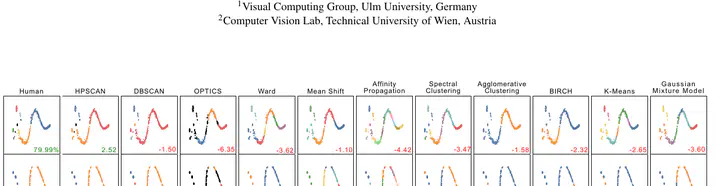
 Figure from the author-uploaded arXiv version.
At a glance
- Learns scattered-data cluster separation from human perception rather than a hand-designed distance rule.
- Uses 7,320 labeled scatterplots collected from 384 participants.
- Processes point coordinates directly with a modified PointNet++ model instead of rasterized scatterplot images.
Motivation
Conventional clustering algorithms optimize mathematical criteria that do not necessarily match how people perceive groups in a scatterplot. HPSCAN asks a different question: which separations would human viewers recognize as clusters?
Method
The authors crowdsourced cluster annotations for 7,320 bivariate datasets from 384 participants. HPSCAN learns from these labels using a modified PointNet++ architecture that receives the scattered point coordinates directly, avoiding the resolution and rendering choices of image-based scatterplot analysis.
Evaluation
The work reports annotation statistics and compares HPSCAN’s separations with human judgments on held-out and real-world data. This makes the target of evaluation perceptual agreement, rather than only agreement with a geometric clustering heuristic.
Limitations
The model is trained on bivariate scatterplots and reflects the judgments represented in the collected dataset. Extending this notion of perceptual clustering to other visual encodings or higher-dimensional interaction contexts remains an open direction.