NormLift: From Lifted Features To Semantic Reliability In 3D Gaussian Splatting
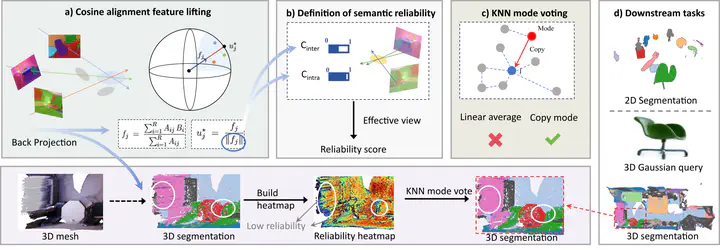 NormLift method overview (Figure 1), by Yihan Zang, Da Li, Dominik Engel, Shinkyu Park, and Ivan Viola. Source: author-uploaded arXiv paper, CC BY 4.0.
At a glance
- Derives normalized semantic back-projection as the closed-form solution of per-Gaussian cosine alignment on the CLIP unit sphere.
- Turns feature magnitude into a semantic reliability signal, calibrated by effective multi-view support.
- Uses training-free mode voting to copy a supported neighbor direction rather than average CLIP features.
Motivation
Training-free semantic lifting assigns 2D foundation-model features to 3D Gaussian primitives, enabling open-vocabulary scene queries. Most explanations optimize reconstruction of 2D feature maps, although downstream 3D segmentation queries each Gaussian independently with cosine similarity. NormLift instead asks which direction on the CLIP unit sphere is best supported by a Gaussian’s observations, and how trustworthy that direction is.
Method
NormLift formulates per-Gaussian feature assignment as a cosine-alignment problem. Its closed-form solution is the alpha-compositing-weighted semantic back-projection followed by L2 normalization. The norm of the unnormalized back-projected feature factors into intra-view concentration and inter-view agreement. Calibration by the effective number of supporting views discounts apparently consistent features dominated by a single view.
The resulting reliability score guides spatial KNN mode voting. Reliable, nearby neighbors vote for semantically consistent candidate directions; a Gaussian adopts a neighbor’s feature only when its support exceeds the Gaussian’s own by a margin. Copying one existing direction avoids introducing another linear mixture of neighboring CLIP features. Semantic lifting and refinement require no gradient-based training, but operate on an already reconstructed 3DGS scene.
Evaluation
The paper evaluates open-vocabulary 3D semantic segmentation on ScanNet using the OpenGaussian protocol with 19, 15, and 10 classes. NormLift reports mIoU of 35.77, 39.62, and 48.93, respectively, with the best mIoU and mean accuracy among the compared methods. Ablations compare reliability-weighted mode voting with no refinement, plain KNN voting, linear averaging, and reliability derived from only the feature norm or view support.
A supplementary rendering-based evaluation on LERF-OVS examines transfer to 2D semantic tasks. In the paper’s V100 runtime comparison with SFS, the shared lifting stage is unchanged: NormLift’s post-lifting stage takes 53.5 seconds on average versus 359.0 seconds for SFS (6.7× faster), producing a 2.0× end-to-end speedup at essentially matched peak GPU memory. These are protocol-specific measurements, not a speedup of 3DGS reconstruction or 2D feature extraction.
Limitations
NormLift treats the reconstructed geometry and alpha-compositing weights as fixed, so reconstruction artifacts propagate into semantic lifting. It also inherits CLIP’s limitations on fine-grained categories, compositional concepts, and out-of-distribution objects. The 3D evaluation covers ScanNet indoor scenes; building-scale, outdoor, and dynamic-scene generalization remains unverified. Mode voting needs reliable spatial neighbors and cannot recover regions whose entire neighborhood has systematically unreliable semantics without additional cues.