RaRa Clipper: A Clipper for Gaussian Splatting Based on Ray Tracer and Rasterizer
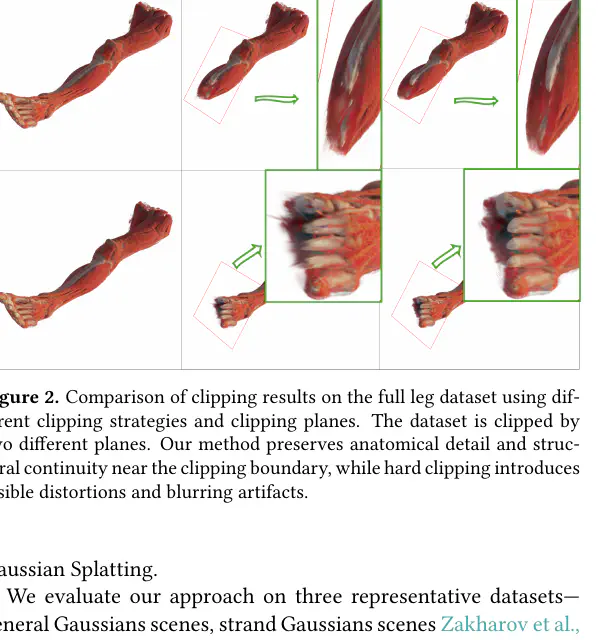 Figure from the author-uploaded arXiv version.
At a glance
- Enables high-fidelity clipping of Gaussian Splatting scenes.
- Combines rasterization and ray tracing to handle the volumetric contribution of Gaussian primitives.
- Evaluates clipping quality against conventional hard clipping in quantitative and user-facing comparisons.
Motivation
Clipping is essential for inspecting interior structure in 3D scenes. For Gaussian Splatting, however, a primitive can contribute to many pixels across a volume, so simply discarding primitives at a clipping plane can produce imprecise boundaries and distracting artifacts.
Method
RaRa Clipper uses a hybrid renderer: rasterization provides efficient visibility handling, while ray tracing resolves the volumetric contributions needed for accurate clipping. The resulting pipeline is designed to preserve both the speed expected from splatting and the spatial fidelity needed at a cut boundary.
Evaluation
The paper compares RaRa Clipper with hard clipping across a set of clipping scenarios, combining image-based measures with participant feedback. The evaluation focuses on the visual clarity of the cut, preservation of surrounding context, and dataset-dependent preferences.
Limitations
Clipping quality remains dependent on the underlying Gaussian representation and viewing configuration. The work also identifies cases where retaining contextual background or choosing the right clipping configuration requires further user control.