At a glance
- Extends monocular depth estimation to semi-transparent volume renderings.
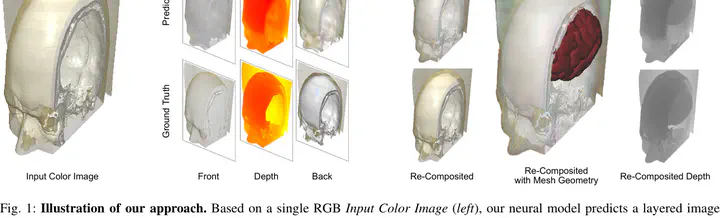
- Predicts a layered representation: front structures, depth of interest, and back structures.
- Enables re-composition with geometry, labels, and alternative shading from a single rendered image.
Motivation
Depth is ambiguous in semi-transparent volume rendering: several structures can contribute to one pixel, and there may be no single visible surface. A useful depth estimate nevertheless enables labels, geometry, and additional shading to be composed with a rendering.
Method
The work studies depth definitions for volume-rendered images and adapts monocular depth networks to predict a layered decomposition. From one RGB rendering, the model estimates front semi-transparent content, the depth of a surface of interest, and structures behind it; the layers can be recomposited with new scene elements.
Evaluation
The evaluation compares depth-estimation approaches across different opacity and illumination settings, and assesses the additional color and opacity predictions needed for layered reconstruction. The resulting layers support downstream re-composition tasks rather than serving only as a scalar depth map.
Limitations
The decomposition is learned from rendered imagery and inherits ambiguities from the rendering setup. It is therefore most useful as an image-space representation for interactive composition, not as a replacement for the original volumetric scene model.